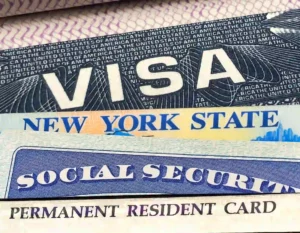
While some couples choose to marry outside of the United States, there are also couples who decide getting married within the U.S. is more desirable. In this case, there are procedures the foreign national must follow to adjust their K-1 visa status, obtain a Green Card, become a permanent resident, and ultimately receive American citizenship, if they so desire. If you are wondering what happens with a K-1 visa after marriage, keep reading.
Upon the foreign national’s arrival to the U.S., through K-1 entry, he or she and the U.S. citizen must get married within 90 days. Once they marry, the K-1 visa holder must apply for an Adjustment of Status so as to keep legal status in the United States. After all, the K-1 visa holder is no longer a fiancé(e), but a spouse.
Failing to marry will result in the sponsored fiancé/fiancée losing their K-1 status. If the couple decides not to get married, the fiancé(e) will not be eligible to legally remain in the United States.
Furthermore, the engaged partner of a U.S. citizen will be required to leave the country right away. It is imperative the couple follows the proper protocol to ensure a smooth transition for the foreign national to move from a K-1 visa status to permanent resident.
What happens to a K-1 Visa After Marriage?
Within the first 90 days of the U.S. citizen’s significant other being in the United States, he or she must submit Form I-485, Application to Register Permanent Residence or Adjust Status. Receiving the Adjustment of Status allows them to legally remain in the U.S., as well as gain conditional permanent residency – a Green Card. This is conditional and is only valid for two years.
After two years, the married couple can now jointly file Form I-751, Petition to Remove Conditions on Residence. Upon acceptance, the Green Card holder will receive a lawful permanent residence card – without conditions.
K-1 applicants should note, nonimmigrant status automatically expires after 90 days of entry into the United States, and it cannot be extended. It is for this reason the K-1 holder must apply for permanent residency.
Steps to File Adjustment of Status (K-1 to Green Card)
In order to get an adjustment of status, the U.S. citizen as well as the foreign national must complete quite a few required forms. The following outlines which forms need to be filled out, and by whom.
- The Application to Adjust Status (Form I-485) is typically submitted shortly after marriage. The foreign spouse usually submits the I-485 within 90 days of arrival to the United States because that’s when the K-1 status expires.
- However, if the marriage is to the original U.S. citizen petitioner, the foreign spouse can still apply after the 90-day period, even if they are technically out of status.
- Applicants file an adjustment application only after the USCIS has approved their petition (Form I-129F).
- The Form I-864 is the Affidavit of Support, to be submitted by the sponsoring spouse, which details financial support of his or her immigrant spouse.
- A Report of Medical Examination and Vaccinations (Form I-693) must be completed by a USCIS-approved physician.
- An Application for Employment Authorization Document (Form I-765) may also be submitted to allow the foreign spouse to work while the Green Card is pending.
- The Form I-131 is the Application for Travel Document, which should be filed at the same time as the I-485 and I-765 if the applicant wishes to travel while the case is being processed.
- Other documents needed from the immigrant spouse are the I-129F Approval Notice, biographic passport page, K-1 visa, I-94 Arrival/Departure Records, four passport-sized photos, and birth certificate. As well as the couple’s marriage certificate.
Unlike other visas, the K-1 does not allow for a visa change to any other temporary visa, like an F-1 or H-1B, for example. Similarly, the foreigner cannot adjust their status from a K-1 visa to a Green Card, based on the marriage to someone other than the original U.S. citizen sponsor.
The Adjustment of Status Interview
Most couples who apply for a Green Card after a K-1 visa will be scheduled for a USCIS interview within 6–12 months. Both spouses must attend.
The officer will review your relationship history, living situation, and supporting documents to ensure the marriage is genuine. This is a key step in confirming eligibility for conditional permanent residence.
Green Card Interview After K-1 Marriage
After two years, the married couple must jointly file Form I-751, Petition to Remove Conditions on Residence, within the 90 days before the conditional Green Card expires.
This petition proves to USCIS that the marriage is still real and ongoing. If the supporting evidence is strong, the interview may be waived. However, in some cases, USCIS will schedule an interview with both spouses to verify the relationship.
A USCIS officer may ask questions about the couple’s personal background, daily life together, vacations, and even details about their wedding and honeymoon.
If the officer determines the marriage is genuine, USCIS will approve the petition, and the foreign spouse will receive a 10-year Green Card. This grants the right to live and work in the United States permanently, without conditions.
Frequently Asked Questions
What do I do after I get married to a United States citizen?
When a foreign citizen joins his or her significant other, and marries them within 90 days, he or she must apply for an Adjustment of Status. Their K-1 visa status will change to a conditional legal permanent U.S. resident. After 2 years, the married couple must attend an interview with a USCIS officer and show proof their marriage is still a bonafide one. Upon approval, the married couple should jointly file a petition to remove the conditions of sponsored spouse’s residency. Once approved, all conditions will be removed, and the foreign national will gain lawful permanent U.S. residency.
What Do I Need to Apply for a K-1 Adjustment of Status?
Several documents are necessary when applying for an Adjustment of Status. Firstly, File Form I-485 and all supporting documents. Others include Form I-693, Report of Medical Examination and Vaccination Record, Form I-864 Affidavit of Support, Form I-131 – if there are plans to travel or gain employment prior to being a permanent United States resident, and I-765, Application for Employment Authorization.
How long does Adjustment of status Take for spouse?
The Adjustment of Status processing times can be quite lengthy. This can take 10 months, and up to 16 months.
How much does it cost to adjust status after a K-1 visa?
As of 2025, USCIS fees for adjustment of status total approximately $2,330. This includes $1,440 for Form I-485, $260 for a work permit (Form I-765), and $630 for a travel document (Form I-131). Always check the USCIS Fee Schedule for the latest updates.
Conclusion about K-1 visa after marriage
When a United States citizen plans to marry someone from another country, they must do so within the first 90 days of the K-1 visa holder’s arrival to the U.S. If the 90 days have passed, the fiancé/fiancée will be out of lawful status. Consequently, he or she (and children – when applicable) must leave the country right away. Failing to do so can potentially lead to being deported and a future ban from entering the United States.
After the couple marries within this 90-day timeframe, the foreign spouse must apply for and receive an Adjustment of Status. He or she will receive a Green Card issued by the USCIS and hence become a permanent United States resident. Such status gives the spouse of the U.S. citizen the right to permanently live and work in the United States.
An Adjustment of Status application packet includes quite a few forms that will need to be submitted simultaneously. The Green Card timeframe usually takes about a year to be approved by the USCIS and received by the foreign spouse. During this time, he or she is will receive employment authorization as well as the ability to travel abroad.
For information about Form I-485, possible ineligibility, grounds of inadmissibility and other bars to adjustment of status, see the USCIS website.
Official Government Resources Cited in this Article
- USCIS (U.S. Citizenship and Immigration Services): https://www.uscis.gov
- USCIS – Fiancé(e) Visa Information: https://www.uscis.gov/family/family-of-us-citizens/visas-for-fiancees-of-us-citizens
- U.S. Department of State – K-1 Fiancé(e) Visa (Consular Process): https://travel.state.gov/content/travel/en/us-visas/immigrate/family-immigration/nonimmigrant-visa-for-a-fiance-k-1.html
- NVC (National Visa Center) Process: https://travel.state.gov/content/travel/en/us-visas/immigrate/nvc.html
- Visa Bulletin (Department of State): https://travel.state.gov/content/travel/en/legal/visa-law0/visa-bulletin.html
- USCIS Filing Fees Page: https://www.uscis.gov/forms/filing-fees